The Shire
The Shire is the homeland of the Hobbits, a small, pastoral region in northwestern Middle-earth that serves as the starting point and emotional anchor of The Lord of the Rings. It is a land of peace, plenty, and insularity, whose sheltered existence is shattered by the War of the Ring, forcing its inhabitants to confront the wider world and ultimately to reclaim their home from within.
Geography and Settlement
The Shire was founded in the year 1601 of the Third Age (Year 1 of Shire-reckoning) when the Fallohide brothers Marcho and Blanco led a great following of Hobbits across the Brandywine River. They had obtained permission from the high king at Fornost, and they took all the land between the river and the Far Downs to dwell in, on condition that they keep the Great Bridge and other roads in repair and speed the king's messengers. The land stretched forty leagues from the Far Downs to the Brandywine Bridge and fifty leagues from the northern moors to the southern marshes. It was divided into four quarters—North, South, East, and West Farthings—each further subdivided into folklands that still bore the names of old leading families. Outside the Farthings lay the East and West Marches, including Buckland and the Westmarch added in S.R. 1452. The Hobbits named it the Shire as the region of the authority of their Thain, a district of well-ordered business, and there they plied their well-ordered business of living, heeding less and less the world outside where dark things moved.
Government and Society
The Shire at the time of the story had hardly any government. Families for the most part managed their own affairs, and growing food and eating it occupied most of their time. The only real official was the Mayor of Michel Delving, elected every seven years at the Free Fair on the White Downs at the Lithe, whose almost only duty was to preside at banquets given on Shire-holidays. The offices of Postmaster and First Shirriff were attached to the mayoralty, so he managed both the Messenger Service and the Watch. The Shirriffs, the Hobbits' police, had no uniforms, only a feather in their caps, and were in practice more concerned with the strayings of beasts than of people. There were only twelve of them in all the Shire, three in each Farthing, for Inside Work, with a larger body of Bounders employed to beat the bounds and see that Outsiders did not make themselves a nuisance. The Thain was the master of the Shire-moot and captain of the Shire-muster and the Hobbitry-in-arms, but as muster and moot were only held in times of emergency, the Thainship had ceased to be more than a nominal dignity. The Took family had long been pre-eminent in this office.
Character and Culture
Hobbits are an unobtrusive but very ancient people, more numerous formerly than they are today. They love peace and quiet and good tilled earth, and they do not understand or like machines more complicated than a forge-bellows, a water-mill, or a hand-loom. They are quick of hearing and sharp-eyed, and though inclined to be fat, they are nimble and deft. They possess the art of disappearing swiftly and silently when large folk come blundering by. In the days of their peace and prosperity, they were a merry folk, dressed in bright colors, notably fond of yellow and green. They seldom wore shoes, since their feet had tough leathery soles and were clad in thick curling hair. Their faces were as a rule good-natured rather than beautiful, broad, bright-eyed, red-cheeked, with mouths apt to laughter, and to eating and drinking. They were hospitable and delighted in parties and in presents, which they gave away freely and eagerly accepted. The Shire-folk were, if it came to it, difficult to daunt or to kill, and they could survive rough handling by grief, foe, or weather in a way that astonished those who looked no further than their bellies and their well-fed faces. Though slow to quarrel, they were doughty at bay and could still handle arms, shooting well with the bow.
The Shadow of the War
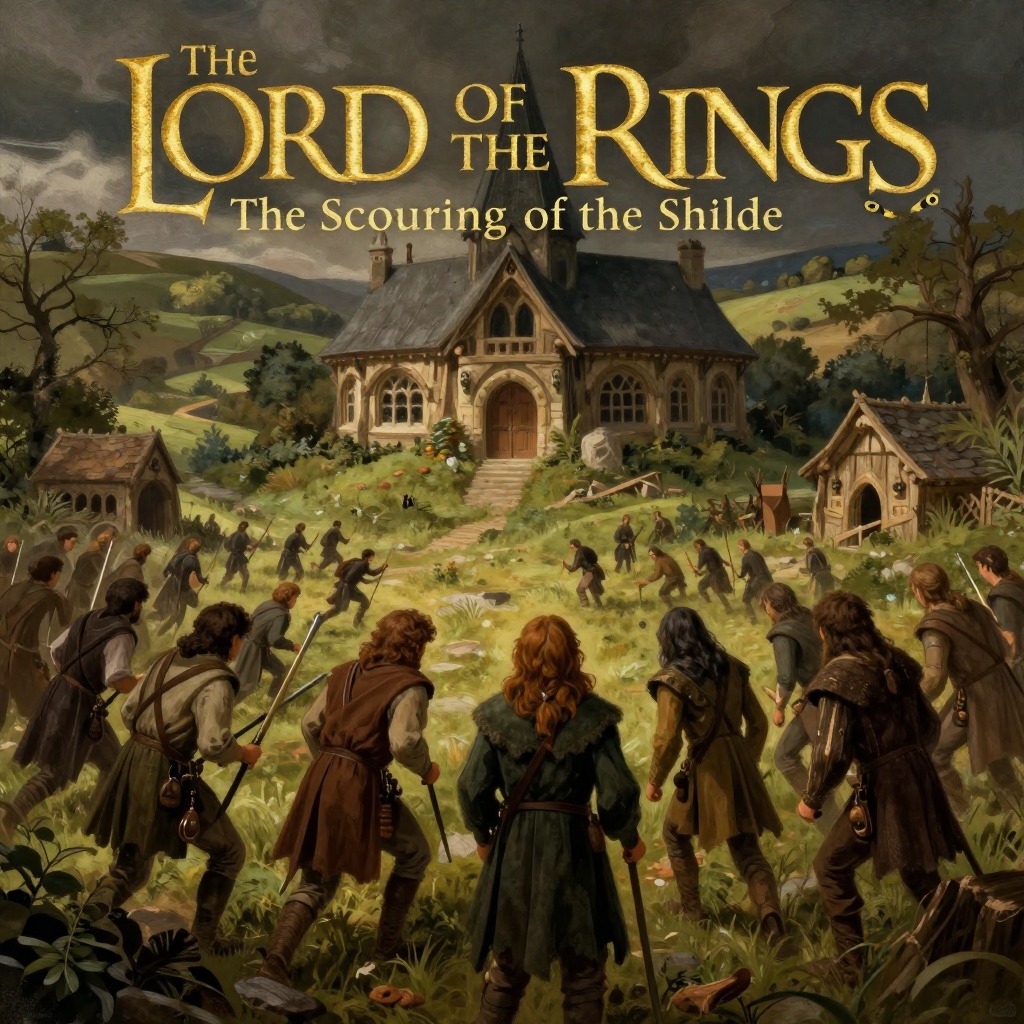
For a thousand years the Hobbits were little troubled by wars, and they prospered and multiplied after the Dark Plague until the disaster of the Long Winter and the famine that followed it. They came to think that peace and plenty were the rule in Middle-earth and the right of all sensible folk, forgetting or ignoring the Guardians and the labours of those that made possible the long peace of the Shire. They were, in fact, sheltered, but they had ceased to remember it. At the time when the story begins, the Bounders had been greatly increased, for there were many reports and complaints of strange persons and creatures prowling about the borders. This was the first sign that all was not quite as it should be. The Shire's peace was shattered when Saruman, through his agent Lotho Sackville-Baggins, took control, felling trees, building ugly new houses, and bringing in ruffians who bullied the inhabitants. The land was scarred, the Party Tree was cut down, and Bagshot Row was dug up into a sand and gravel quarry. The four Travellers—Frodo, Sam, Merry, and Pippin—returned to find their home under this oppression and raised the Shire-folk in the Battle of Bywater, the last battle fought in the Shire. After the war, the Shire was restored and entered a golden age of plenty, with the mallorn tree planted in the Party Field as a symbol of renewal. King Elessar made it a Free Land under the protection of the Northern Sceptre, and the Westmarch was added to it by his gift.